Wednesday, August 24, 2011
On the Heaven-Scented breeze....
I used to feel like blogging a large percentage of the time. I’d jot down ideas and later expand them into blog entries. But this summer I feel too private for that. I’ve turned inward and isolated myself (and my emotions) from others.
Part of that is that I feel somewhat unfocused a lot lately, and part is because I think I just put too much “out there” too often. But I think I am beyond that; for a while at least.
At night, many people in this community like to sit in their backyards and make bonfires. Part of this is to make smoke to keep the mosquitoes and blackflies at bay while part I think is the call of our ancestors who used to make open fires to cook food and for protection from predators. (Today the predators are other humans it seems) Frequently, the wood of choice is ocean driftwood, salty, pungent and somewhat unpleasant at times. Tonight however, someone is burning what smells to me like sugar Maple; sweet, reminiscent of the fires that used to burn in people’s stoves and furnaces when I was a child in New Brunswick.
This smell, along with the memories it triggered, got me thinking about our senses and how we use them and so in this entry, I will begin a series of blogs focused on our senses.
Smell, I think of all of our senses, can trigger so many memories, emotions, and sensations. Take the smell of a wood fire for example. Where I grew up, fires were used primarily for heat in the winter. Being a province rich in wood lands, our homes, were heated mostly by wood as were other buildings such as the “shack” at the skating rink where we put our skates on and occasionally thawed frozen toes and fingers; so to me, a wood fire brings back memories of winter with its sounds of snow crunching beneath our feet, the sight of the smoke from chimneys, sometimes laying flat against the rooftops, sometimes rising straight up to the heavens.
I can’t smell freshly cut grass without thinking of our little dead-end street in the early summer evenings. After the final meal, the men would head out and mow the lawns while the women washed the dishes and got the youngest of the children ready for bed. As we grew, the boys of the households became the mowers of the lawns while our fathers did other, more meaningful things, like smoke cigarettes and drink tea. Yet, even today, several hundred miles from that street, I have only to smell freshly cut grass and I am back on my street, in my village, in my family home.
Food smells are also a great trigger. Coffee made in an old-fashioned percolator can nearly always drag me back to my aunt Ruby’s house on a Saturday morning. (It’s odd how a certain smell can be associated with one certain place even though the smell itself is more universal) Bacon and eggs in a cast-iron frying pan takes me to the cottage, affectionately known as “the Camp” or “The Doughboy.” (No idea where that came from) Turkey and the trimmings will forever be Christmas day with Mom and Dad. Apple pie is generally associated with a favourite restaurant of long ago. French Fries and cotton candy are of course a Carnival.
Growing up, I spent a lot of time in the forests surrounding our village. Fir, spruce, cedar, and pine trees were constant companions and I knew their scents intimately. I knew also the scent of spring, of the earth returning to life after a long, cold winter. I am familiar with the pungency of the decomposing leaves in autumn. The scents of animals; skunks (of course) bears, the wild cats and foxes all hold a place in my memory and even my heart.
More recently is the ocean, and while it pretty much surrounds me, there is one place that comes to mind when I smell the salt air. It is a short walk from this very house and I spent a lot of time there when I first came to this area. It has no real significant meaning to me other than I always remember it as being where I truly came to know the sea.
There can be unpleasant and frightening smells too: The smell of a burning old building, coated in coal dust, will forever remind me of the day I nearly lost my life in a fire that took all things musical from me. The smell of a forest fire still touches me with dread, such is its fury and uncertainty.
Gasoline, motor oil, and grease, all remind me of special people and places. My father worked for many years as a delivery man for Esso, and so always smelled of petroleum products. My cousin was handy with wrenches and always had a car or two on the operating table. Later, some of my high school buddies had less-than-reliable cars and so were frequently working on them to keep them going. Being inside those cars, the smells associated with them were ever-present.
The places I have performed throughout my musical career generally had distinctive smells. Many smelled of stale beer and cigarette smoke, but they all had something else as well. Perhaps it was the cleaning products that were used (there is one that always reminds me of school too) or the cologne of the bartender;
Which brings me to people scents. I can go some places and know if a certain person is already there or I am aware when they arrive, just by the smell of the air. People, even those who don’t use scented products all have a characteristic scent. Granted, it sometimes requires a certain level of intimacy to get close enough to notice, but it is there. I have encountered it during embraces and it is often very much the way their homes smell as well. One home I visited always smelled of apples, and the inhabitants did too!
What smells or odours remind you of good times and great people? What turns you off? What brings up unhappy memories or frightens you? I’d love to hear from you.
~Still Wandering…


Saturday, August 6, 2011
Finally, a chance to catch up…

As you can see, it has been a while since I have posted here on this blog. There are many reasons for this, and while I make no excuses, I will offer a few explanations.
To begin with, there has been little to write about that would offer more than a sentence or two. Since (in my opinion) this would make for less-than-stimulating reading for my readers, I have remained silent.
Another thing that kept me away is a situation that arose within the household. My wife needed retinal surgery and the operation was performed on June third of this year. This required several trips to Halifax; once for an examination, once for the surgery, and a number of follow-up examinations. If any of you have had this operation, or know someone who has had it, you will know that the recovery requires the patient to remain very still for an extended period of time, gradually returning to a normal life. (Although “normal” surely changes for someone who has experienced this) Again, blogging “I put drops in her eye again,” would have bored you all to tears so I didn’t bother. I am happy to report that as of her last appointment on August third, she is in full recovery and “normal” can once again be attempted.
The weather this summer in our little corner of the world has been less than conducive to adventure and exciting things to write about. Rain, cold, wind; we’ve experienced it all with very little sunshine and warm temperatures. Mosquitoes rule the backyard this year, and everyone’s short-tempered and listless. By this time last year, I had over a thousand kilometres on my bicycle, and if I’ve managed five hundred this year it would be a miracle. I’ve done a couple of important (to me at least) rides; The Ride of Silence, which I lead in May, The Heartland Tour in July. I took part in a Canada Day parade with Velo Cape Breton followed by a ride around Edwardsville/Point Edward/Northwest Arm which was fun and invigorating. But besides a few one-hour rides locally and an afternoon of “noodling” around, I haven’t really been out much.
I started physiotherapy to begin re-building my body after a back injury in October. This has only served to verify my awkwardness and reinforce the knowledge that while I am seeing some improvement, it will be an ongoing process, and I am plagued with insecurity and doubt. That I believe is an inherited behaviour.
Finally, Bad Habits have been steady, but not too much really exciting work has come our way aside from the week of Seaside Daze in Dominion NS. That was really fun and we got two nights out of it, the best of which was the Fireworks display on July thirty-first. While the evening started out cool and breezy, it warmed up once the wind calmed and we had a blast (pun intended) playing and watching the fireworks, which was reported to be the best in the CBRM. I have included a picture of myself (as well as a video) taken during that show. It seems fairly obvious that I really DO love playing my drums.
~Still Wandering…
Sunday, April 24, 2011
Copyright and Taxes
With a Canadian Federal election coming up in just over a week, party leaders are all vying for votes, saying what they think the majority of constituents want to hear in order to get them.
There has been a great deal of activity recently in Canadian Parliament by the Harper Conservatives, attempting to bring Canada’s copyright laws into parity with those of the U.S. There are rumours from both the Conservatives and Liberals, led by Michael Ignatieff, that a tax or surcharge will be added to such devices as iPods, iPhones, MP-3 Players etc. There is already a tax on recordable media such as blank CDs, DVDs, cassette tapes and so on.
What I’d like to address today is the inherent unfairness and inequality of such a tax.
While I can understand the notion of compensation for the creators of written, recorded, and televised works, I cannot buy the idea that copyright laws and taxes protect the “artists.” To understand what I mean by this, let’s look a bit deeper into the matter.
I, as a drummer, am considered to be one of these artists; a title I wear willingly and with a certain measure of pride. I have performed onstage and on recordings with a vast array of other artists, some of whom are household names, and intend to do so again for a number of years. But if copyright laws and taxes are to ensure the artists receive compensation, I am here to assure you that they do not!
The truth of the matter is that when I perform onstage, I get paid for the performance. Period! Putting this in perspective, I began learning my craft at about 10 years of age. I learned consistently for many years by observation, asking questions, and eventually paying for lessons. I’ve put a lot of time into honing my craft, practising for many hours every day for years, all unpaid. On days when I perform, I make sacrifices so I will have adequate time and energy to get to and play at the gig. I arrive at least an hour before start time and stay a half hour after we finish in order to set up and pack away my drums. Our gigs last for an average of four hours and I arrive home at sunrise and as a result the following day is generally lost to me as well. For all this, I receive a sum of money that many people earn in a couple of hours.
In the recording studio it is a bit different but often not much better financially. Generally in the studio, the days are long, (often ten to twelve hours) and the sessions frequently take three to five days. Again, for this, I am paid generally fifty percent more than I receive for a live performance. Note: Once I am done with both the onstage performances and the recordings, there is no further compensation for me or many other band members. Why is this? Simply because copyright laws cover “intellectual properties,” meaning the person who came up with the idea (lyrics, music, concept etc.) is the person to whom the money is sent, and then only if they belong to an organization that ensures they receive said money.
For example, in 1994 I was involved in a recording where I added a line to a song. According to copyright laws, I am entitled to financial compensation every time a copy of that album is sold, but because I am not a member of SOCAN (Society of Composers, Authors and Music Publishers of Canada) there is no way of them even knowing of my contribution. Considering that I am not likely to ever become known as a songwriter, and considering that my lyrical contribution to that one song was just that; one time; there is little sense in me belonging to SOCAN or any other such organization.
So, now that I`ve established how the copyright laws DO NOT protect artists, let`s look at tariffs, taxes, and surcharges on recording and storage media.
While conceptually, these things can be, (and frequently are) used to copy already existing works, as in the case of borrowing a CD or DVD and making a copy of it, (thereby circumnavigating a sale) they can also be used to store one`s OWN works.
For example, if Canadian author Margaret Atwood writes a novel and wishes to give a copy to her publisher, it would make sense for her to copy the text to a CD and deliver it that way, rather than to print it off onto “hard copy;” real paper. A songwriter who is looking to be published or wants to submit his/her works to famous performers in the hope that said works will be recorded, will submit said works on a CD. If I shoot a video on my camcorder and want to share it with my friends or family, I can burn it to DVD copies and send them to members of my family and friends.
In all these cases, no copyright laws were broken and yet we are being charged extra “hidden” taxes (something the Canadian GST was supposed to eliminate) in the form of surcharges for the CDs and DVDs we buy for these purposes. This money then goes in small part to the writers, of songs, books and screenplays, but in large part to the distributors of recorded, printed, and filmed works, and in NO WAY back to me for the home video I shared.
Let me make this a bit more clear. If I write a song, and have my band record it, and SONY CANADA distributes it to all the “record stores” in Canada, I will receive a small percentage of the sales, my band will receive nothing, (unless I decide to share with them) and SONY will receive the largest percentage of the monies received through sales. Therefore, when you make a copy of that CD for your cousin, I will lose pennies, my band will lose nothing, but SONY will lose dollars! How is this fair to or in any way protecting the artists?
Additionally, many products that are released onto the market today have “anti-copy” software embedded that makes them work only in the first device into which they are inserted. In other words, if you buy a CD, and play it in your car on the way home, then take it into the house and try to play it in your Home Theatre system, it will not play. It turns out there is a detection device implanted that will recognize only your car stereo. A friend of mine took a CD into work and tried to play it in his work computer only to have that computer freeze and fail to work again until he reformatted the hard drive. Is that really fair? He BOUGHT the CD, was not attempting to copy it, and had he not been computer savvy, would have lost a lot of work-related information when the computer crashed.
I do not really care how you choose to vote on May 2, but I ask you to be aware of the insidious, underhanded legislations being negotiated today in Canada and how those legislations will affect you and your fellow Canadians. Ask questions of your candidates. Hold them accountable for the actions of Parliament. After all, you and so many other Canadians are paying their salaries. Do not let Canada become a cheap knockoff of the insane activities we see to the south.
~Still Wandering...
There has been a great deal of activity recently in Canadian Parliament by the Harper Conservatives, attempting to bring Canada’s copyright laws into parity with those of the U.S. There are rumours from both the Conservatives and Liberals, led by Michael Ignatieff, that a tax or surcharge will be added to such devices as iPods, iPhones, MP-3 Players etc. There is already a tax on recordable media such as blank CDs, DVDs, cassette tapes and so on.
What I’d like to address today is the inherent unfairness and inequality of such a tax.
While I can understand the notion of compensation for the creators of written, recorded, and televised works, I cannot buy the idea that copyright laws and taxes protect the “artists.” To understand what I mean by this, let’s look a bit deeper into the matter.
I, as a drummer, am considered to be one of these artists; a title I wear willingly and with a certain measure of pride. I have performed onstage and on recordings with a vast array of other artists, some of whom are household names, and intend to do so again for a number of years. But if copyright laws and taxes are to ensure the artists receive compensation, I am here to assure you that they do not!
The truth of the matter is that when I perform onstage, I get paid for the performance. Period! Putting this in perspective, I began learning my craft at about 10 years of age. I learned consistently for many years by observation, asking questions, and eventually paying for lessons. I’ve put a lot of time into honing my craft, practising for many hours every day for years, all unpaid. On days when I perform, I make sacrifices so I will have adequate time and energy to get to and play at the gig. I arrive at least an hour before start time and stay a half hour after we finish in order to set up and pack away my drums. Our gigs last for an average of four hours and I arrive home at sunrise and as a result the following day is generally lost to me as well. For all this, I receive a sum of money that many people earn in a couple of hours.
In the recording studio it is a bit different but often not much better financially. Generally in the studio, the days are long, (often ten to twelve hours) and the sessions frequently take three to five days. Again, for this, I am paid generally fifty percent more than I receive for a live performance. Note: Once I am done with both the onstage performances and the recordings, there is no further compensation for me or many other band members. Why is this? Simply because copyright laws cover “intellectual properties,” meaning the person who came up with the idea (lyrics, music, concept etc.) is the person to whom the money is sent, and then only if they belong to an organization that ensures they receive said money.
For example, in 1994 I was involved in a recording where I added a line to a song. According to copyright laws, I am entitled to financial compensation every time a copy of that album is sold, but because I am not a member of SOCAN (Society of Composers, Authors and Music Publishers of Canada) there is no way of them even knowing of my contribution. Considering that I am not likely to ever become known as a songwriter, and considering that my lyrical contribution to that one song was just that; one time; there is little sense in me belonging to SOCAN or any other such organization.
So, now that I`ve established how the copyright laws DO NOT protect artists, let`s look at tariffs, taxes, and surcharges on recording and storage media.
While conceptually, these things can be, (and frequently are) used to copy already existing works, as in the case of borrowing a CD or DVD and making a copy of it, (thereby circumnavigating a sale) they can also be used to store one`s OWN works.
For example, if Canadian author Margaret Atwood writes a novel and wishes to give a copy to her publisher, it would make sense for her to copy the text to a CD and deliver it that way, rather than to print it off onto “hard copy;” real paper. A songwriter who is looking to be published or wants to submit his/her works to famous performers in the hope that said works will be recorded, will submit said works on a CD. If I shoot a video on my camcorder and want to share it with my friends or family, I can burn it to DVD copies and send them to members of my family and friends.
In all these cases, no copyright laws were broken and yet we are being charged extra “hidden” taxes (something the Canadian GST was supposed to eliminate) in the form of surcharges for the CDs and DVDs we buy for these purposes. This money then goes in small part to the writers, of songs, books and screenplays, but in large part to the distributors of recorded, printed, and filmed works, and in NO WAY back to me for the home video I shared.
Let me make this a bit more clear. If I write a song, and have my band record it, and SONY CANADA distributes it to all the “record stores” in Canada, I will receive a small percentage of the sales, my band will receive nothing, (unless I decide to share with them) and SONY will receive the largest percentage of the monies received through sales. Therefore, when you make a copy of that CD for your cousin, I will lose pennies, my band will lose nothing, but SONY will lose dollars! How is this fair to or in any way protecting the artists?
Additionally, many products that are released onto the market today have “anti-copy” software embedded that makes them work only in the first device into which they are inserted. In other words, if you buy a CD, and play it in your car on the way home, then take it into the house and try to play it in your Home Theatre system, it will not play. It turns out there is a detection device implanted that will recognize only your car stereo. A friend of mine took a CD into work and tried to play it in his work computer only to have that computer freeze and fail to work again until he reformatted the hard drive. Is that really fair? He BOUGHT the CD, was not attempting to copy it, and had he not been computer savvy, would have lost a lot of work-related information when the computer crashed.
I do not really care how you choose to vote on May 2, but I ask you to be aware of the insidious, underhanded legislations being negotiated today in Canada and how those legislations will affect you and your fellow Canadians. Ask questions of your candidates. Hold them accountable for the actions of Parliament. After all, you and so many other Canadians are paying their salaries. Do not let Canada become a cheap knockoff of the insane activities we see to the south.
~Still Wandering...
Thursday, April 14, 2011
Ride of Silence

I began cycling as a seven year old when my father bought me a second-hand CCM from another boy in the village. Between that time and the time I turned fourteen, I probably had another four bikes. Some I outgrew, while others I didn’t take care of properly, resulting in their early demise.
When I became a musician in the early ‘70s, cycling was left behind as the behaviour of a child. However, it was only for a year or two since ten-speed bicycles were becoming the rage among young adults for a number of reasons.
First, they were inexpensive to operate, using no gas and requiring no expensive insurance, registration, and parts.
Secondly, they were environmentally non-threatening, and the environmental movement was beginning to gather momentum. I had to do with a three-speed that I bought second-hand since I couldn’t afford a true ten-speed at that time.
When I moved to the city after high school, I was able to buy a ten-speed, and became a “cyclemuter,” choosing to ride as much as possible instead of driving the car. In this way, I was able to explore the city at a slower pace, and get to places the car was unable to go.
I continued to ride until the early ‘80s when that old ten-speed was stolen, and I was financially unable to replace it.
In 1993, I bought a mountain bike; ill-fitting and heavy, but I rode it until I lost it in a fire in 1997. Again I stopped riding until I bought a second ten-speed at Value Village in 2001. I managed to get a summer out of it and inherited another mountain bike the following spring.
Finally, in 2008, I purchased a Norco Mountain bike from Framework Cycles and Fitness in Sydney NS. I rode that bike as much in the following year as I’d ridden altogether since 1997. Finally in the spring of 2010, I bought a Devinci road bike.
Built with the dropped handlebars and sleek design of my earlier ten-speeds, but with a lighter frame and better gearing system, this machine was ... IS, the one I’ve waited my whole life to ride.
One of the most important issues for me is bicycle safety. I’m not sure why, but motorists seem to have a grievance against cyclists over fifteen years of age. As long as you’re a child on a bike, you are not discriminated against, but as soon as you’re old enough to drive a car, you’re expected to not ride a bike. That to me seems ludicrous, and Velo Cape Breton as well as many other clubs, both formal and informal are proof of this.
While doing an internet search one evening looking for safety tips, I came across the Ride of Silence, and was immediately drawn to it. “This is something that makes a very clear statement, without saying a word,” I thought. I brought it to the attention of Velo Cape Breton’s Jacques Coté, and asked if it was something he thought should be looked at for this area.
Fast forward to early May 2010, and Jacques had taken it upon himself to have a Ride of Silence organized and advertised. As soon as I was aware that it was proceeding, I e-mailed all my friends and talked it up as much as I could. The ride drew over sixty riders of all age groups and from every walk of life and riding style, from casual infrequent riders to hardcore racing/triathlon riders.
This year’s ride will take place on May 18th beginning at 6:30 PM at the Sydney River Superstore, 1225 King’s Road Sydney River NS. Riders will proceed along King’s Road, to Townsend Street, turning right and proceeding to the intersection at George Street. At George, the procession will turn left and follow George St to its Northernmost end. The procession will then turn left onto Ortona, left again onto Esplanade and proceed to the Civic Centre, 320 Esplanade, where there will be a public assembly.
After the assembly, additional riders who are not inclined to travel the entire distance will join the main ride for another loop around the downtown area, from Townsend to Ortona and back to the civic centre where the main group will continue on the return to the Superstore.
The Ride of Silence occurs on the third Wednesday of May annually. Riders ride single file, at a slow speed, (maximum 20 km/hr) in complete silence. International Ride of Silence organizer, Chris Phelan in Dallas Texas asks us to treat it as a funeral procession in order to keep everything in perspective.
I encourage everyone to show your support for this cause by either riding with us, or by attending the assembly at the Civic Centre. It won't take much time out of your day, and it will be a great step in bringing attention to cycling and increasing safety for us all.
~Still Wandering (this time on two wheels)...
Tuesday, March 15, 2011
Help Japan.
Hello.
I met this guy through a mutual friend. His appeal for help in Japan is both personal and touching. Help if you can, but if you can't help, leave a comment or sent me a message which I'll pass along to him. As he says, "They need something to tell them that life's gonna be okay."
Thank you.
http://www.youtube.com/user/WarmothStrat#p/u/0/dX96LFV3zBE
I met this guy through a mutual friend. His appeal for help in Japan is both personal and touching. Help if you can, but if you can't help, leave a comment or sent me a message which I'll pass along to him. As he says, "They need something to tell them that life's gonna be okay."
Thank you.
http://www.youtube.com/user/WarmothStrat#p/u/0/dX96LFV3zBE
Sunday, March 13, 2011
End Times?
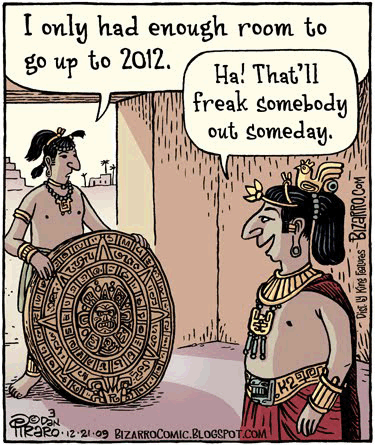
With the recent devastating earthquakes in New Zealand and Japan, as well as last year’s event in Haiti, it is easy to believe that we are in our final days. Add the predictions of Nostradamus and the Mayan calendar which “runs out” on the winter Solstice of 2012, and it seems almost a certainty.
I think however that the sudden annihilation or destruction of our planet is quite far-fetched. Cataclysmic events are not new to this chunk of rock with life upon it; going back to the extinction of the dinosaurs we can see that life forms exist, cease to exist, and new ones come to be. If the predicted asteroid collision becomes a reality, life will still exist on Earth, and our technological advances will ensure that at least some humans will survive.
Theories abound as to just how our end will come about. Some say we will be hit by the before-mentioned asteroid, others say sun-spot activity will knock out our electrical grid and leave us defenseless against the elements. Still others think it will be a more esoteric event.
Owen Waters, author of “The Shift” has said that while an end is coming, it is an end to a destructive way of thinking. He believes that our destructive habits; mining, cutting of the rainforests, pollution of our air and water, will come to an end as human values shift from material wealth to spiritual enlightenment.
That seems to be something to look forward to.
But what of all these earthquakes and tsunamis? Surely there must be something to that?
While it might seem there is an increase in the frequency of these events, and that the severity also seems to be increasing, we have all heard rumors, and conjecture that “the big one” is coming. I’m well into the advanced stages of middle age and I’ve been hearing of this impending doom my entire life. I don’t think there are more earthquakes and volcano eruptions than in the past, but that we are more informed about them. CNN, CBC News Network, and CTV News Channel broadcast images 24/7 for the morbidly curious. While it can be said that the tremors are tipping the Richter scale with higher numbers than in recent history, evidence shows that in the past there were equally large quakes and tsunamis, and yet we are here.
While it might seem we are safe here in Atlantic Canada, I remember in the early 1980s waking up to feel my apartment shaking, and there were at least two aftershocks that day. More recently, there was another earthquake in the same area, albeit a mild one.
However, we are not completely out of danger. The entire surface and sub-surface of our home planet is in a constant state of flux, not just in the Pacific region but all over. In fact, a few years ago I saw a show on television which explained how part of the topography of western Nova Scotia was once in Africa!
With evidence like that, how can anyone possibly believe we are safe from anything?
~Still Wandering...
Thursday, February 24, 2011
How Our Technology Has Let Us Down...
In the mid-1980s, I was on tour with a young woman singer from Brampton Ontario. As is the custom of most musicians, the first day I had free after arriving in a new town, I would go to the local music store to see what was in stock. At each and every store, I would see one or more sets of Simmons electronic drums which were the rave at the time and the only electronics available back then. I was not a fan of them and, being as vocal as I am with my opinions, voiced my preference for traditional acoustic drums. The arguments I heard in favour of the electronics ranged from, “The sound man has more control” to “They’re so easy to record” to “They’re always in tune.” All valid points, I must concede, but all refutable as well.
Those discussions though, were a great insight into the way non-drummers saw us; those of us who hit things with sticks. At first I was offended by these statements, but I began to look at them for what they were; the truth as seen from the perspective of others.
Then I began to look at why others had that perspective.
Could it be that they had encountered so many drummers who could not play softly? Surely that was true in some cases, but if we go back far enough, pre–Rock and Roll, we can find all sorts of examples of drummers who could play with fiery intensity and be barely heard, and then unleash a barrage that would frighten the hounds of Hell back to their lair.
And what about electronics being easier to record? By today’s standard, I would have to say yes, they are. Set up the pads, connect them to the module, connect the module to the mixing board, and lay down the tracks. No microphones to put up, no experimenting with placement, no time lost. I can only assume that applied to those earlier pads as well, and today’s pads and modules are much better.
But they aren’t infallible. If the module goes down, the whole drum kit is gone. If in an acoustic drum situation, a microphone goes south, it can be replaced quickly and easily.
Which leaves us with tunability. Electronic instruments rely upon circuitry to provide the sounds we desire. If we don’t like a certain sound, we tailor the module to compensate. If we want higher or lower tone, the module can do that. If we want pitch bend or overtones, the module can do that.
Finally, there’s the actual recording studio of the twenty-first century. Gone are the days of huge rolls of tape and reel-to-reel recorders. Today, it’s all digital, using computer software programs such as ProTools or Adobe Premier Pro. These programs allow the engineer to “go in” and move sounds to make them more metronomically correct, or to duplicate them so the same part can be used in another section of the song. It is possible that the piano or guitar player on your favourite song did not play completely from start to finish, but played a verse and chorus that were then duplicated as many times as necessary to get the finished product.
Recently, I was listening to some demo tracks one of the students at McKenzie College was working on. He was explaining how he still had to go back and electronically repair some timing inconsistencies. I asked why he didn’t just play it right when he recorded it.
Which brings me to the point of this blog: We depend too much on the technology that was designed to assist us. Many drummers today do not know how to tune their drums or play with dynamics; they believe it’s up to someone else to “fix it in the mix.” Vocalists don’t have to sing in key; pitch bend takes care of that. Timing isn’t important anymore; that can be quantized.
Music today isn’t being made by musicians, but by studio technicians.
Another way our technology is letting us down is in the area of social media.
WHAT? The Lonster is dissing Twitter and Facebook? E-mail? Sup wit dat?
Well, I’ll tell you, but before I do, please let me reassure you, I am not dissing them, I’m simply pointing out how they can be abused and unhelpful; possibly even harmful to the relationships they were designed to enhance.
I often find statements made, words “spoken” in e-mails of on social forums are misunderstood, taken out of context, or completely confusing to myself or others. There is something, ... dare I say “sacred,” about person-to-person conversations wherein we can draw upon such additional information as body language, facial expression, or eye contact. A straight-to-the-point “What do you mean?” can set things straight immediately if necessary.
Now, I’m not advocating we give up our computers, blackberries, or even paper and quill, but I DO suggest getting out and having conversations with friends and family over dinner or coffee as often as possible. Time shared this way is time that will lead to great memories and stronger friendships or family bonds. Time spent this way will be the topic of future conversations, either real or on the virtual plane.
Time spent this way will never be wasted...
~Still Wandering…
Those discussions though, were a great insight into the way non-drummers saw us; those of us who hit things with sticks. At first I was offended by these statements, but I began to look at them for what they were; the truth as seen from the perspective of others.
Then I began to look at why others had that perspective.
Could it be that they had encountered so many drummers who could not play softly? Surely that was true in some cases, but if we go back far enough, pre–Rock and Roll, we can find all sorts of examples of drummers who could play with fiery intensity and be barely heard, and then unleash a barrage that would frighten the hounds of Hell back to their lair.
And what about electronics being easier to record? By today’s standard, I would have to say yes, they are. Set up the pads, connect them to the module, connect the module to the mixing board, and lay down the tracks. No microphones to put up, no experimenting with placement, no time lost. I can only assume that applied to those earlier pads as well, and today’s pads and modules are much better.
But they aren’t infallible. If the module goes down, the whole drum kit is gone. If in an acoustic drum situation, a microphone goes south, it can be replaced quickly and easily.
Which leaves us with tunability. Electronic instruments rely upon circuitry to provide the sounds we desire. If we don’t like a certain sound, we tailor the module to compensate. If we want higher or lower tone, the module can do that. If we want pitch bend or overtones, the module can do that.
Finally, there’s the actual recording studio of the twenty-first century. Gone are the days of huge rolls of tape and reel-to-reel recorders. Today, it’s all digital, using computer software programs such as ProTools or Adobe Premier Pro. These programs allow the engineer to “go in” and move sounds to make them more metronomically correct, or to duplicate them so the same part can be used in another section of the song. It is possible that the piano or guitar player on your favourite song did not play completely from start to finish, but played a verse and chorus that were then duplicated as many times as necessary to get the finished product.
Recently, I was listening to some demo tracks one of the students at McKenzie College was working on. He was explaining how he still had to go back and electronically repair some timing inconsistencies. I asked why he didn’t just play it right when he recorded it.
Which brings me to the point of this blog: We depend too much on the technology that was designed to assist us. Many drummers today do not know how to tune their drums or play with dynamics; they believe it’s up to someone else to “fix it in the mix.” Vocalists don’t have to sing in key; pitch bend takes care of that. Timing isn’t important anymore; that can be quantized.
Music today isn’t being made by musicians, but by studio technicians.
Another way our technology is letting us down is in the area of social media.
WHAT? The Lonster is dissing Twitter and Facebook? E-mail? Sup wit dat?
Well, I’ll tell you, but before I do, please let me reassure you, I am not dissing them, I’m simply pointing out how they can be abused and unhelpful; possibly even harmful to the relationships they were designed to enhance.
I often find statements made, words “spoken” in e-mails of on social forums are misunderstood, taken out of context, or completely confusing to myself or others. There is something, ... dare I say “sacred,” about person-to-person conversations wherein we can draw upon such additional information as body language, facial expression, or eye contact. A straight-to-the-point “What do you mean?” can set things straight immediately if necessary.
Now, I’m not advocating we give up our computers, blackberries, or even paper and quill, but I DO suggest getting out and having conversations with friends and family over dinner or coffee as often as possible. Time shared this way is time that will lead to great memories and stronger friendships or family bonds. Time spent this way will be the topic of future conversations, either real or on the virtual plane.
Time spent this way will never be wasted...
~Still Wandering…
Subscribe to:
Posts (Atom)